Mats Alvesson about our organizations

Mats Alvesson on 'Functional Stupidity' & 'The Triumph of Emptiness'


In order to meet the various challenges of current times (circular economy, industrial ecology...), our business practices must change and become more sustainable.

Will the management methods that we currently apply and teach make such a change possible? “No”, answers Mats Alvesson. His analysis shows how far our companies' daily life appears to be from the surrounding reality and his contribution constitutes a salutary step backwards in our disturbed times.

The Social-Network Illusion That Tricks Your Mind

Network scientists have discovered how social networks can create the illusion that something is common when it is actually rare.


One of the curious things about social networks is the way that some messages, pictures, or ideas can spread like wildfire while others that seem just as catchy or interesting barely register at all. The content itself cannot be the source of this difference. Instead, there must be some property of the network that changes to allow some ideas to spread but not others.

Today, we get an insight into why this happens thanks to the work of Kristina Lerman and pals at the University of Southern California. These people have discovered an extraordinary illusion associated with social networks which can play tricks on the mind and explain everything from why some ideas become popular quickly to how risky or antisocial behavior can spread so easily.

Network scientists have known about the paradoxical nature of social networks for some time. The most famous example is the friendship paradox: on average your friends will have more friends than you do.

This comes about because the distribution of friends on social networks follows a power law. So while most people will have a small number of friends, a few individuals have huge numbers of friends. And these people skew the average.

Here’s an analogy. If you measure the height of all your male friends. you’ll find that the average is about 170 centimeters. If you are male, on average, your friends will be about the same height as you are. Indeed, the mathematical notion of “average” is a good way to capture the nature of this data.

But imagine that one of your friends was much taller than you—say, one kilometer or 10 kilometers tall. This person would dramatically skew the average, which would make your friends taller than you, on average. In this case, the “average” is a poor way to capture this data set.

Exactly this situation occurs in social networks, and not just for numbers of friends. On average, your coauthors will be cited more often than you, and the people you follow on Twitter will post more frequently than you, and so on.

Now Lerman and co have discovered a related paradox, which they call the majority illusion. This is the phenomenon in which an individual can observe a behavior or attribute in most of his or her friends, even though it is rare in the network as a whole.

They illustrate this illusion with a theoretical example: a set of 14 nodes linked up to form a small world network, just like a real social network (see picture above). They then color three of these nodes and count how many of the remaining nodes link to them in a single step.

Two versions of this setup are shown above. In the left-hand example, the uncolored nodes see more than half of their neighbors as colored. In the right-hand example, this is not true for any of the uncolored nodes.

But here’s the thing: the structure of the network is the same in both cases. The only thing that changes is the nodes that are colored.

This is the majority illusion—the local impression that a specific attribute is common when the global truth is entirely different.

The reason isn’t hard to see. The majority illusion occurs when the most popular nodes are colored. Because these link to the greatest number of other nodes, they skew the view from the ground, as it were. That’s why this illusion is so closely linked to the friendship paradox.

Lerman and co go on to tweak the parameters of the network, by changing the distribution of links and so on, to see how the majority illusion depends on them. It turns out that the conditions under which the illusion can occur are surprisingly broad.

So how prevalent is it in the real world? To find out, Lerman and co study several real-world networks including the coauthorship network of high-energy physicists, the follower graph of the social-media network Digg, and the network representing links between political blogs.

And the majority illusion can occur in all of them. “The effect is largest in the political blogs network, where as many as 60%–70% of nodes will have a majority active neighbours, even when only 20% of the nodes are active,” they say. In other words, the majority illusion can be used to trick the population into believing something that is not true.

That’s interesting work that immediately explains a number of interesting phenomena. For a start, it shows how some content can spread globally while other similar content does not—the key is to start with a small number of well-connected early adopters fooling the rest of the network into thinking it is common.

That might seem harmless when it comes to memes on Reddit or videos on YouTube. But it can have more insidious effects too. “Under some conditions, even a minority opinion can appear to be extremely popular locally,” say Lerman and co. That might explain how extreme views can sometimes spread so easily.

It might also explain the spread of antisocial behavior. Various studies have shown that teenagers consistently overestimate the amount of alcohol and drugs their friends consume. “If heavy drinkers also happen to be more popular, then people examining their friends’ drinking behavior will conclude that, on average, their friends drink more than they do,” say Lermann and co.

In other words, blame the majority illusion.

That’s important, but it is not yet a marketer’s charter. For that, marketers must first be able to identify the popular nodes that can create the majority illusion for the target audience. These influencerati must then be persuaded to adopt the desired behavior or product.

That’s a goal that any good marketer will already have identified. At least now they know how and why it can work.

Ref: arxiv.org/abs/1506.03022 : The Majority Illusion in Social Networks


mrnorwood
Pardon me if I'm a bit underwhelmed by this bit of "science". So people over-attribute social prevalence to traits exhibited by socially influential people (i.e. celebrities of one sort or another)... didn't we all already know this? Isn't this why marketers use celebrities (or mini-celebrities, i.e. "super influencers") to do their endorsements? Isn't this why Jenny McCarthy was able to create an international anti-vaxxer movement? Isn't this why people have body image issues -- because they spend all day looking at pictures of people who are professionally beautiful? Isn't this why kids grow up thinking that they have a pretty good chance of being a professional athlete or actor or singer -- because they spend all day paying attention to the exploits of the handful of such people who exist in the world? Who didn't already know this?

The last sentence in the article seems absurd to me. "People have known for ages that you can use water to make things wet, but now SCIENCE has explained for the first time why that works: it turns out that water has the property of wetness!" Huh?


Chris Boese
OK, I have what is probably a stupid question, not about the network illusion illustrated secondly, which I get.

My question is about the AVERAGE HEIGHT thing, where averaging would make it seem that the majority of your friends are taller than you (or have more friends than you).

Regarding height, why would the tilt of an unbalanced average always be ADDITIVE? TALLER? Isn't there an equal and opposite chance that it could be subtractive? That the majority of your friends are shorter than you? I mean, from a math standpoint (and not a protein in a culture's diet over time standpoint), an average doesn't care if it is off-balanced UP or DOWN. What is it about height that makes it additive in groups, in the straight math?

I can see where friend counts might tick up, just like we all seem to be gaining weight, so calories tick up too, without you knowing it. But height is just a snapshot of a culture, of a group. It is a stable measure. It DOES tick up for children, because they are growing. And to a lesser extent, it even ticks downward, slightly, for the elderly.

Maybe I'm just missing something obvious. I just can't feature how an average would be able to distinguish right from left, up from down, adding from subtracting, to make it tilt toward the additive side of the equation.

If you are ADDING subjects to the averaging pool, that also wouldn't seem to make it tick up consistently. It adds numbers to the total, but the average is still the reductive average, and, like a grade point average, the more items added to the pool DIMINISH the impact of all the other items. That's why one C your second semester freshman year makes your GPA swoon, while only one C, registered near the end of your lazy senior year barely makes your GPA wiggle. (GPAs most surely do not always tick up!)
Valton
@Chris Boese I think that's because, in both cases, one side of the tilt is limited, and the other is not. You cannot have less then 0 friends in a social network. Neither you can have less than 0,000001cm heights (in bizarro world). On the other side, there is no limit. You can have a trillion friends, or be 1km high (again, in bizarro world). When the average number of friends of an individual is, lets say 200, a friend on the lesser extreme will have 199 friends less than you. On the higher extreme, someone will have 999.999.999.9800 (or something like that) firends more than you... so the deviation on the average will be always towards more friends.... because you cant have someone with -1 trillion friends to counterbalance it.


patricjean
I have a question (sorry for my english).

The same illusion exists in the traditional medias where few people are speaking all day long, expressing more or less the same king of opnion.If you watch tv (in France for example) you could think that everybody agrees on many points of view.

Do you think that the illusion is stronger in the traditionnal medias or in the social networks ? And why?


Lizaloop
I'd like to see this diagram expanded into a state sequence similar to the "game of life". We'd need to add a parameter for the probability that a recipient node would share the message. It's clear that, in the initial state, it matters whether the red nodes have many or few connections. But, in the simplified network presented, no red node is directly connected to another red node. You have to get to the second or third state to begin to "go viral". In real social networks influencers are usually connected to each other. They may also be more likely to forward messages. Of course, message transmission phenomena have no relationship to the value or veracity of message content. Clearly more study of this is needed if we are to survive in a social-media permeated world governed democratically by popular public opinion.


Rumplestiltskin
Anything appears to be "common" when the human psyche is continually bombarded with news from every angle and also by an all too eager alternative press to reference each other by the hundreds, so that we hear of something over and over. Our senses tell us that it must be "common" because we hear of it all the time in the numbers, regardless of the truth.

This is precisely what Joseph Goebbles used in his propaganda machine, believing that if a lie is told often enough and thoroughly enough, it will be believed as fact. How else could a small nation managed to whip up its citizenship to accept genocide as the only alternative method of righting their society after the banking cabal's wrecking of its economy.

Lies told often enough begin to seen as truth, thus common. Now that the scientist have figured out how easy it is to manipulate us, the manipulators of our society will have a field day pushing their agenda, because our human brains want to believe, as it is part of our tribal safety mechanism. Thus we believe whatever we are told, and even more so when we are told the same thing hundreds of times a day.

I know we have enough laws, but seriously, there should be a law against using language to manipulate and obfuscate truth.


Warren Whitlock
I've always said that reality is just the most popular illusion. In that past, this applied to social groups of geographical areas, but as our ability to connect expands, so does our illusion that what we see is all there is.

Fortunatly, more connects mean an increase in the likelihood that we see evidence that our illusion is not reality.


zacernst
The reason why an average person's friends have more friends on average than they do has nothing whatsoever to do with a power law. It's because people with more friends than average are more likely to be your friends. That's all.

Re: N.N. Taleb about the hegemonic epistemology

The death of Popperian Science and the new age of ignorance, thanks to science journalism. Science is moving from fallibilism to councils of cardinals declaring what is right.


Economics versus political economy is like ethics without metaphysics

Open Web Vancouver 2009 Day 2 -20090612-7

If I cover an eye, the world will only be half as bad

Untitled

Where do our moral judgments come from?


Via Flickr:
Jonathan Haidt at TED2012: Full Spectrum. February 27 - March 2, 2012. Long Beach, CA. Photo: James Duncan Davidson


According to moral foundations theory, morality begins as a set of evolution-derived intuitions, which each child then learns to apply within his or her culture. Haidt suggests six dimensions or categories or foundations, into which nearly all our intuitions fall:

1) help those in need and minimize suffering everywhere (the care/harm foundation);
2) reward people according to what they contribute (fairness/cheating);
3) advance the fortunes of your group (loyalty/betrayal);
4) defer to legitimate superiors and protect subordinates (authority/subversion);
5) resist domination by illegitimate authority (liberty/oppression);
6) respect your group’s totems and taboos (sanctity/degradation).

Churchill Club Top Ten Tech Trends 2012

Via jurvetson on Flickr:
This is the most difficult speaking event, by far, that I take on, and somehow I keep coming back.
Just spank me with that red paddle!

Five panelists are asked to come up with two tech trends that we think are worthy of the top 10 title, and that are, as they instruct:
1) Not obvious today
2) You believe there will be explosive growth in about five years’ time

When you do this for many years, it gets harder and harder. For several years now, I have done this, and have to come up with new ones each year. If it's too obvious, it's boring. If it's too radical, it might not be relevant over the next five years. And it had to be important and new... worthy of a top 10 tech trend.

So, here are the 10 trends...

What do you think? Which do you agree most with? Disagree most with? Think are too obvious?

Trend 1. Radical Globalization of Social Commerce (Kevin Efrusy)
In prior cycles, international segments consisted of 30-40 percent of revenue, begun 3-5 years after the US effort. Going forward, "ROW" can dominate domestic, and players who wait to address it are vulnerable to competitors who go global first.

Trend 2. Zero Marginal Cost Education (Bing Gordon)
In the 1970s, ATMs were considered “dehumanizing” and bank tellers were the gold standard. But tellers got worse, while ATMs improved. Public education seems to be repeating this pattern, and the oligopolists of “big education” don’t seem to have read Innovator’s Dilemma.

Trend 3. Massive Sensors and Data (Reid Hoffman)
Sensors cost trends to zero; there are sensors everywhere and part of everything. In combination, we'll create multiple data collections that power applications and innovations to improve our lives. Genetics, disease, and symptom data for automate tri-corders, precision diagnosis, and personalized medicine. Collaborative filtering of all kinds of discovery– from music to information to professional training.

Trend 4. All Vehicles Go Electric (Steve Jurvetson)
Eventually all motor vehicles will transition to an electric drive train, affording greater efficiency, convenience, and a multitude of new design options. Within five years, this inevitability will become clear.

Trend 5. A Shift Toward Technocracy: Doing More with Less (Peter Thiel)
Democrats want government to do more with more. Republicans say government should do less with less. Technology might allow it to do more with less.

Trend 6. It's Just the Venture Cycle (Kevin Efrusy)
The fortunes of Silicon Valley rarely mirror the rest of the world because the ebb and flow of creative disruption follows a different pattern and 14-16 year cycle than the macro economy. We appear to be right on schedule...

Trend 7. Gamification of Everything (Bing Gordon)
As Lance Armstrong wrote, “Every second counts.” As digital natives increasingly multi-task, and as the social web creates geometric growth in posts, the battle is for engagement. For the growing population of game-players, reportedly 70% of Americans, games are important systems for creating meaning, and can increase behavior by 25 to 100%.

Trend 8. The New Hardware: Bits to Atoms (Reid Hoffman)
Open Source patterns now applied to hardware. Collective design bases with rapid modifications. Flexible manufacturing producing limited run and unique devices. 3D printing means revolution in custom and unique goods. Ultimately, revolutions in biological and medical products and solutions.

Trend 9. Moore's Law Accelerates Beyond Silicon (Steve Jurvetson)
When we consider Moore’s Law in the abstract, the dropping cost of computation is not tapering off. Rather it will accelerate further still as we look beyond the silicon era.

Trend 10. The Beginnings of Bioinformatics; Intelligent Design Over Random Drug Discovery (Peter Thiel)
More powerful computers will turn biology into an information science.

jurvetson

you can start here. I argued that from a customer value measure, Moore’s Law itself will accelerate beyond what Intel and Moore himself would predict. This will come from radically new architectures and new ways to compute.

The EV trend must not be obvious because all of my fellow VC panelists disagreed. Here are my notes on what I argued:

First: the importance: the U.S. spends $2B per day (+$4B if you count indirect costs) on oil, mostly for our vehicles. Larger than the entire Internet market

While most everyone agrees that we have to eventually get off oil if you look far enough in the future (think 10,000 years), the question is when and how. Not if.

Why go electric? Even if you want to burn oil, fracked gas, or a biofuel, for some reason, it’s better to do it in a centralized plant because of the heat loss in small engines. A modern Siemens cogen plant is 70% efficient. Our cars are 20%. EVs like Tesla are 88% efficient.

I showed a slide with images of a bunch of gorgeous cars coming out in the next 18 months. All of these cars have a lower total cost of ownership than a Taurus.

Convenience: almost no maintenance for an EV. Mainly tires.

Cambrian explosion of body plans:
• Small motor size - > flexibility
• Model X: Falcon-wing doors: access and storage of a minivan + outperforms a Porsche 911
• Google Robocars – need drive by wire.

Why now? 29 new electric drive train vehicles in next 18 months. First generation of native EVs shipping this year.

FedEx: so proud of their new electric fleet, they are doing test drives over at the Rosewood.

Air quality? China has to go electric.
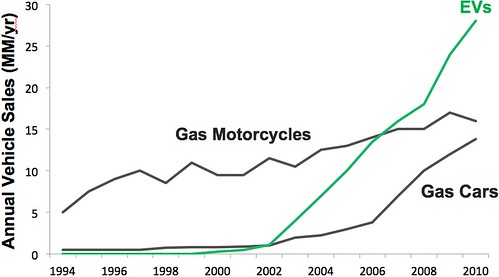
Surprise! There are 200M EVs on road today in China, built by 1,300 different Chinese manufacturers.
Mostly electric scooters. Uptake started with SARS (people feared public transportation), and then they discovered the the total cost of ownership is less than the public bus fare (even with VRLA battery replacements).

Here's the growth curve I pulled together with Weinert from Chevron and now Bosch China:


Screen Shot 2012-06-08 at 11.17.43 AM

Now the largest of those Chinese eBike manufacturers are making “four wheel bikes”

If China does not go electric, and instead buys more gas-burning cars by 2050 than exist on the road today (as is forecast), the planet is screwed.

In the future, when all vehicles are electric, we will look back to the current era and marvel that there were a billion oil-burners driving around the planet wasting 80% of their energy as heat and applying only 0.3% of that energy to moving the passenger.

The Tech Trend prediction is not that we will change a billion vehicles in 5 years, by no means, but that hopefully we can change a billion minds. We used to take cigarette smoking as a given. It should be much easier to give up our addiction to oil and our smoking cars, because the new EVs will be so much more affordable, convenient and fun.


seatonsnet

I hate to be a party pooper, but I think the major trend in the next few years is going to be the increasing pauperization of the middle class in developed countries leading to a fracture in elemental social cohesion, with the cost of food turning much of the developing world into riot and terrorism prone failed or semi-failed states, which would most probably lead to an extremely toxic political environment. Also the increasing resistance of bacteria to antibiotics, www.bloomberg.com/news/2012-05-07/drug-defyin g-germs-from... may make the coming decades look like 14th century Europe

Prioritization

ProductCamp Boston has just met and here are the slides from a presentation on Advanced Roadmapping for Product People


The Copernican Question

Under what conditions do people change or give up beliefs to which they are most deeply committed?


The Copernican System

After an audit...


Entrepreneuring in Online Social Networks: From Brokerage vs. Closure to Brokerage and Closure

This work takes a structuration view of entrepreneuring in online social networks.  Social capital theory informs the idea that network entrepreneurship is a function of brokerage and closure qua agency and structure, respectively.  The purpose of this undertaking is to extend existing theory to the emerging phenomenon of network entrepreneuring as it applies to a little understood, yet rich in potential, area of social action, online networking.  The importance of this contribution is to extend existing theory to, and indicate the empirical potential of, online social networks, while revealing the entrepreneurship dynamics that are essential to the networks’ formation.

Introduction

In online social networks, connecting strangers is entrepreneuring.  Wikipedia defines a virtual community as “a social network of individuals who interact through specific media, potentially crossing geographical and political boundaries in order to pursue mutual interests or goals. One of the most pervasive types of virtual community includes social networking services, which consist of various online communities.[1]”  Using the internet to enable individuals the traversal of boundaries defines network entrepreneurship; successful entrepreneuring results in online social networks.   
Online social networks have come a long way from the early days of Usenet, the worldwide-distributed discussion system organized by subject, yet we know little about how the role of the network entrepreneur.  Today’s online social networks represent the “ new era of democratic and entrepreneur networks and relations where resources flow and are shared by a large number of participants with new rules and practices” (Lin, Cook et al. 2001). Facebook, arguably the most successful online social network to date, boasts an active membership in excess of 500 million, that spends over 700 billion minutes per month on its website as reflected also by the “over 900 million objects that people interact with (pages, groups, events and community pages). [2]”  Flickr, an online network of photography enthusiasts reported on its blog that it hosted 5 billion photos as of September 19, 2010.[3]  As well, by January 2011, LinkedIn, the online networking site for professionals, has reached over 90 million members at a membership rate of one new member per second.[4]  These data points suggest that online networks are emerging as an important social phenomenon whose implications can hardly be overstated, yet we are only beginning to grasp. 
The internet, as network of networks, makes it trivial to set up networks, yet people do not seem to simply aggregate in online social networks.  This is the role of the network entrepreneur, to identify the networking opportunity round a social focus, and create the social network accordingly.  The current work is a theory driven exploration that considers the entrepreneurial opportunity in online social networks as interplay between agency and structure.  The thrust of the theoretical argument is one whereby the perception of value between brokerage and closure explains, and is explained by, the structural evolution of the social network.  The contribution is a model describing entrepreneurial opportunity in online social networks.
 This work continues by theoretically positioning network entrepreneurship as a structuration process whereby the entrepreneur is prompted by network structure and associated perceptions of value into action.  Next, the connection between network structure and value is made by means of social capital.  After a summary of the relations along network structures, types of social capital and network actions is created, the whole analysis is redone in the particular context of online social networks, which change the prior relations among structure, value and action.  Next, a couple of examples from Flickr illustrate different alignments along structure, value and action.  In closing, there is the section discussing the results and evaluation the methodological implications for future research.


[1] http://en.wikipedia.org/wiki/Virtual_community
[2] http://www.facebook.com/press/info.php?statistics  Accessed January 20, 2011. 
[3] http://blog.flickr.net/en/2010/09/19/5000000000/  Accessed January 20, 2011.
[4] http://press.linkedin.com/about/ Accessed January 20, 2011.


Setting the Stage for Empirical Research in Virtual Social Networks

This work sets the theoretical stage for future empirical investigations of the socio-economic dynamics in virtual social networks (VSN), at member and network entrepreneur levels.  In so doing, I start by identifying the empirical loci, Flickr and LinkedIn, justify and describe the choices.  A model of the utility function of the generic VSN member is followed by descriptions of the value dynamics for each VSN, which in turn create the premise for an economic model of VSN as platforms for multi-sided markets.  The model is built by considering several theoretical angles from the perspectives of microeconomics and sociology of networks.  The contribution is in extending theoretical and empirical insights across disciplines and fields with the idea of exploring and understanding the emerging VSN-phenomenon.

Complementarity of Industry-level vs. Firm-level Factors Leading to Consolidation in the ERP Industry


Three firms control now 43% of the enterprise software applications market, whose growing revenue is projected by Gartner to surpass $253.7 billion in 2011.[1]  This level of industry concentration is part of an ongoing trend that characterizes the declining stage in an industry lifecycle model (Porter 1980). As such, the research opportunity is to build a formal model to explain the industry factors leading up to such high levels of concentration, while being able to capture firm level strategies as well.  Moreover, given the magnitude of change in a relatively short period of time in this industry, the transformation that is still going on makes for a quasi-natural experiment, whereby the researcher can test theory driven hypotheses. 

It is my objective in undertaking this work to build a testable model that answers the following research question:  What are the industry-level vs. firm-level factors leading to industry consolidation in the enterprise software applications industry?  The immediate contribution would be to establish conceptual and methodological linkages between industry and firm level factors leading up to consolidation higher concentration.  In other words, a potential contribution is to expose the often-ignored ‘conduct’ part in the structure-conduct-performance paradigm.  At a later stage, the model is to be tested not only on the focal industry herein, but also on other industries.

The industry level working hypothesis is that a significant decrease in environmental munificence triggers both the emergence of a dominant design, and a shakeout in the industry (Utterback et al. 1993; Klepper et al. 2005).  The emerging dominant design in the enterprise software industry realizes platform economies—of scale, scope and skill—by vertically integrating complementary assets (Teece 1986; Rothaermel et al. 2005).  The formal model suggests that the enterprise software applications market tends to settle towards the Bertrand equilibrium around the marginal cost of the most efficient player.


[1] Gartner is one of the top information technology groups of industry analysts.  The source of this quotation is at: http://www.gartner.com/it/page.jsp?id=1535314


When the world runs short of excuses

Attending a conference on entrepreneurship, there was a contest whose finalists included a team entrepreneuring a new idea for a dating website:  Dinner for 6.

This is obviously a great idea, and that's not because there are not already too many dating sites out there, but because it gives people a plausible excuse to get together about, and round, fundamentals.

In a world debased of meaning, where people go to great lengths as if to avoid addressing the fundamentals, we need a good pretext or alibi to reengage more than ever.  


Using her sickness as a pretext

Using her sickness as a pretext

Accession Number: 1990:755
Display Title: Using her sickness as a pretext
Suite Name: 
Media & Support: Opaque watercolor and gold on paper
Creation Date: ca. 1760
Creation Place/Subject: India
State-Province: Rajasthan
Court: Kishangarh
School: Rajasthani
Display Dimensions: 6 11/16 in. x 5 7/16 in. (16.99 cm x 13.81 cm)
Credit Line: Edwin Binney 3rd Collection
Label Copy:
EDWIN BINNEY 3RD GALLERYTHE CHILD KRISHNA INSTALLATION

There is much poetry devoted to the heroine sick with love. Here three women attend a reclining maiden. One, dark of skin, stoops to embrace the stricken lady, and the two lock gazes. Is it a love game, so often played by the gopis, where, in Krishnas absence, they pretend to be him? Has the dark-skinned girl been chosen to lighten the heart of the love-sick girl by pretending to be Krishna coming to the bedside of his beloved? """

The Five Most Popular Talks Given at TED

(according to NYMag)


1. Ken Robinson on Creativity
“By the time they get to be adults, most kids have lost the capacity to take a chance. They have become frightened of being wrong. Our education system has mined our minds in the way that we strip-mine the earth: for a particular commodity. And for the future, it won’t serve us.”


2. Jill Bolte Taylor on Her Own Stroke
“In the course of four hours, I watched my brain completely deteriorate in its ability to process all information. At first I was shocked to find myself inside of a silent mind. But then I was immediately captivated by the magnificence of the energy around me.”


3. David Gallo on Underwater Life
“Today we’ve only explored about 3 percent of what’s out there in the ocean. And in a place where we thought there was no life at all, we find more life, we think, and diversity and density than the tropical rain forest, which tells us that we don’t know much about this planet at all.”


4. Arthur Benjamin on Mathemagics
“I combine my loves of math and magic to do something I call ‘mathemagics.’ I know as a magician we’re not supposed to reveal our secrets. [But] without any more stalling, here we go. Now, 57 times 68 is 3,400 plus 476 is 3,876, that’s 38,760 plus 171, 38,760 plus 171 is 38,931 … ”


5. Hans Rosling on Stats
“I would like to compare Uganda with South Korea with Brazil. You can see that the speed of development is very, very different, and the countries are moving more or less at the same rate as money and health, but it seems you can move much faster if you are healthy first than if you are wealthy first.”